
 Resources
Police Were Called on My Teen: Can Residential Treatment Help?
Published On 03-11-2026
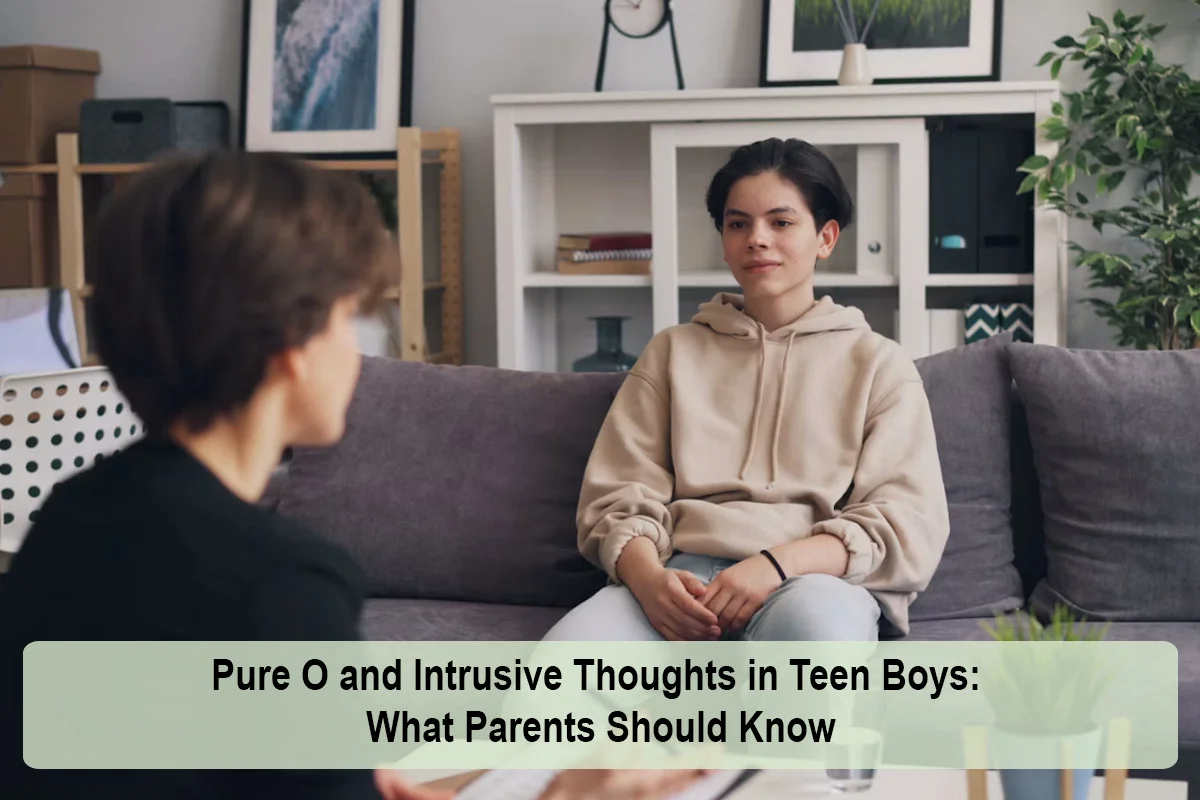
"What if I'm secretly a bad person? What if I lose control and hurt someone, even though I'd never want to? I keep going over it in my head, again and again, to make sure I'm not."
A teenage boy with these thoughts may look fine on the outside. He is not washing his hands for an hour or checking locks. But inside, he is fighting an exhausting battle with unwanted thoughts and silent rituals. This pattern is often called "Pure O," and it is a form of obsessive-compulsive disorder (OCD). Because the compulsions are invisible and boys are often taught to keep fears to themselves, Pure O in teen boys is frequently missed or mistaken for depression, anxiety or "just being moody."
This guide explains what Pure O really is, the common themes of intrusive thoughts, why parents overlook it in boys, the red flags to watch for, how to talk with your son and how treatment works. If your son talks about suicide or self-harm, call or text the 988 Suicide and Crisis Lifeline, or call 911 in an emergency.
"Pure O" is short for "purely obsessional." It describes OCD in which the obsessions, unwanted and distressing thoughts, images or urges, are obvious to the person, but the compulsions happen mostly in the mind. The National Institute of Mental Health describes OCD as involving obsessions, unwanted thoughts that keep coming back, and compulsions, repeated and excessive behaviors, and notes that symptoms usually begin between late childhood and young adulthood.
The name is a little misleading. The Child Mind Institute explains that it is extremely rare for someone to have obsessions with no compulsions at all. In Pure O, compulsions are present but hidden, taking the form of mental rituals such as reviewing, checking or reassuring oneself.
How common is OCD in young people? The International OCD Foundation estimates that about 1 in 200 children and teens have OCD, and that one-third of adults with OCD first developed symptoms in childhood.
| Feature | Ordinary worry | Classic OCD | Pure O |
|---|---|---|---|
| Thoughts | Realistic concerns that pass | Intrusive, distressing obsessions | Intrusive, distressing obsessions, often taboo or frightening |
| Compulsions | None | Mostly visible: washing, checking, ordering | Mostly mental: reviewing, analyzing, self-reassuring |
| Visibility to parents | Easy to notice | Usually noticeable | Often hidden |
| Time consumed | Minimal | Significant | Significant, but silent |
| How the teen feels about thoughts | Mild concern | Distressed | Deep shame, fear of what thoughts "mean" |
Intrusive thoughts tend to target what a person values most, which is why they feel so disturbing. Common themes include:
The key point for parents: intrusive thoughts are not wishes, plans or hidden desires. Teens with Pure O are horrified by these thoughts precisely because they go against who they are.
According to the Child Mind Institute, mental compulsions can include:
Other common hidden rituals include praying or "neutralizing" a bad thought with a good one, testing their own reactions, researching online for reassurance, and avoiding people, places or media that trigger thoughts. Some rituals do leak out, especially repeated questions like "Do you think I'm a good person?" or "Are you sure that's okay?"
Many boys learn early to hide fear and sadness. A son with frightening thoughts may stay silent rather than risk seeming weak.
Teens with Pure O often fear that describing their thoughts will make parents think they are dangerous or immoral. This shame keeps symptoms secret, sometimes for years.
Because rituals are invisible, symptoms may be labeled as general anxiety, depression, ADHD or attitude problems. Without asking specifically about intrusive thoughts and mental rituals, clinicians can miss OCD.
OCD often occurs alongside depression and anxiety. If your son seems hopeless or talks about self-harm, seek help right away.
Start by making it safe. You might say: "Lots of people get thoughts that pop into their head and won't leave, even scary or weird ones. Having a thought doesn't make it true or mean you want it. If that ever happens to you, you can tell me, and I won't freak out."
Normalize without minimizing. Everyone has odd thoughts; what makes OCD different is how stuck and distressing they become. Avoid reacting with shock if he shares a disturbing thought. Thank him for telling you.
Helpful questions include: "Do you ever get thoughts you can't shake?" "Do you find yourself going over things in your head to feel sure?" "Is there anything you avoid because it brings on bad thoughts?"
Be careful with reassurance. It feels kind to say "Of course you're not a bad person," but repeated reassurance can feed the OCD cycle. A therapist can coach you on responding with support instead, such as: "That sounds like the OCD talking. I know it's hard. I believe you can handle not being sure."
Hidden rituals take time and energy. A boy who spends hours reviewing thoughts may fall behind in homework, reread the same page repeatedly or freeze on tests. He may avoid friends or activities linked to his fears, or seem distant at family meals because he is caught in his head. Over time, constant doubt can erode self-worth, and some boys begin to believe they are fundamentally broken. Recognizing these effects as symptoms, not character flaws, is the first step toward help.
Consider an evaluation if intrusive thoughts and mental rituals take up a lot of time, cause significant distress, or interfere with school, sleep, friendships or family life. Ask for a clinician experienced with OCD in adolescents, and make sure they ask about mental compulsions, not just visible rituals. Our guide to signs of OCD in teens covers the broader picture.
The International OCD Foundation describes cognitive behavioral therapy with exposure and response prevention as the treatment of choice for OCD in young people. In ERP, a teen gradually faces the thoughts and situations he fears while resisting compulsions, including mental ones. The Child Mind Institute notes that because mental rituals cannot be seen, ERP for Pure O is more conversational, with teens working through thoughts out loud, and anxiety decreases over time as they learn to tolerate uncertainty.
A therapist might build a step-by-step ladder, starting with easier tasks such as writing "Maybe I'll never be completely sure" and resisting the urge to review, and gradually moving to harder exposures tailored to the teen's specific fears.
For moderate to severe OCD, a psychiatrist may recommend an SSRI. The International OCD Foundation notes that full effects may take 10 to 12 weeks. SSRIs require close monitoring in young people.
Parents learn to reduce reassurance and accommodation in a supportive way. Family therapy can help the whole household respond consistently.
Acceptance and commitment therapy and mindfulness-based approaches can help teens relate differently to thoughts, alongside ERP.
Look for clinicians trained in ERP for adolescents. If OCD is severe or combined with depression or substance use, an intensive outpatient program or residential treatment may help. Compare OCD treatment programs, programs for teen boys and programs for adolescents. Many health insurance plans cover OCD treatment; ask providers to verify benefits. You can also search FindTreatment.gov or call the SAMHSA National Helpline at 1-800-662-4357.
Pure O in teen boys hides behind silence, shame and invisible rituals, but it is real OCD and it is treatable. The most important message you can give your son is that thoughts are not actions and do not define who he is. Make it safe to talk, avoid feeding the reassurance cycle, and connect him with a clinician who understands mental compulsions and ERP. With the right help, many teens learn to let intrusive thoughts come and go without letting them run their lives.
This article was reviewed by the RehabsNearMe Editorial Team for accuracy, clarity, and relevance. Information may be sourced from publicly available treatment resources, government agencies, and healthcare references where applicable.
Last reviewed: November 2026
Resources
 Resources
 Resources
 Resources